 1M+


November 28, 2026
Most Instagram-Worthy Honeymoon Spots in India
Planning a honeymoon around photography sounds rather shallow until you actually look at your wedding album five years down the track. Most people spend months getting their outfits and wedding venues sorted, then head straight into their honeymoon where every single landmark is a tour bus, the midday sun is a complete washout, and half the photos are just awkward selfies taken at arm’s length.
India offers you a tremendous amount of visual variety in a single flight network, yet the very places that look absolutely stunning in a travel brochure can be utterly disappointing in reality. A famous monument is effectively ruined when 200 complete strangers are standing behind you in neon windbreakers. Good honeymoon photos are all about three practicalities: reliable light, quiet access early in the morning and backdrops which don’t fight what you’re wearing.
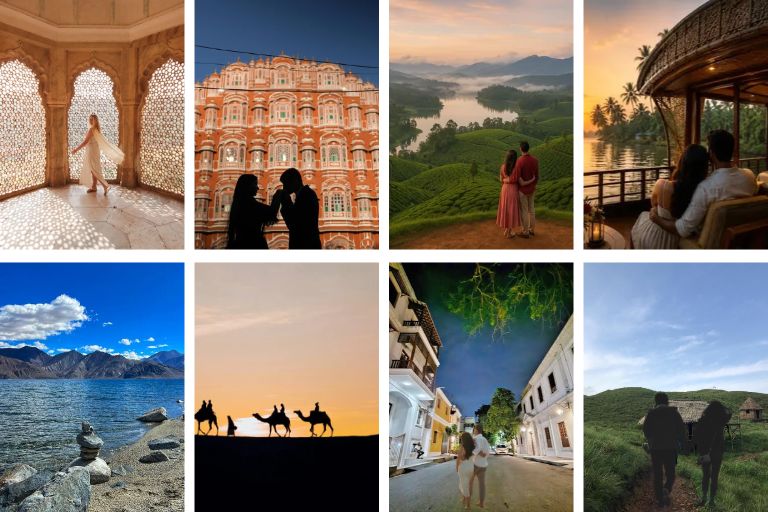
The eight destinations listed below offer very different visual settings, from mountains and deserts to islands and historic towns. More than that though, each one provides a genuine way for couples to get some really clean, unhurried images without their holiday becoming a complete and total photoshoot.
Morning light on the water in Udaipur
Udaipur is a city which works beautifully for couples as it’s all about water and pale stone which naturally acts as a giant reflector. Between October and February the air in the early mornings is cool and crisp, and Lake Pichola becomes a flat mirror before the tourist boats even start at 9 am. If you walk down to Gangaur Ghat or Ambrai Ghat at sunrise, you get the soft pink and gold light hitting the arches, with the arched marble pavilions framing the water behind you.
Most couples make the mistake of booking their boat ride at noon. The direct overhead sun is a nightmare on the white plaster walls of the lakeside palaces, and you just have to squint in the photos. Book your private wooden boat for 4:30 pm instead. As the sun drops behind the Aravallis, the sandstone facades are a warm amber, and you can shoot from the open deck without anyone else leaning into your frame.
For accommodation, have a look at the heritage havelis in the old city which have private rooftop terraces rather than the large chain hotels that are all outside town. A quiet terrace is ideal for having your candid breakfast photos with your masala chai and the domes of the City Palace right in the background. Stick to the deep jewel tones (emerald green, rust, navy blue etc.) in your outfits so you stand out nicely against the cream and white architecture.
Sculpted green slopes and valley mist in Munnar
Munnar is all about replacing the old stone with sweeping geometry. The hills are covered in tightly clipped tea bushes which form a series of curved, overlapping waves down the slopes. The plantations sit above 1,500 metres, where cool mist settles into the valleys at night and then slowly lifts between 7:30 and 9 am. That very brief window of time in the morning produces a lovely layering in the photographs with the foreground tea leaves being quite sharp and saturated and the distant ridges gradually fading into pale grey fog.
The public viewpoints along the main highway to Mattupetty get very crowded very quickly, and the roadside railings often spoil the wide shots. You get far better shots if you book a boutique stay right in the middle of a working private tea estate in places like Suryanelli or Chinnakanal. The estate guests can go for walks along the narrow, dirt plucking tracks in the early hours of the morning with absolutely no outside traffic.
The weather in the Western Ghats changes very quickly even in the post-monsoon season (September to March) so pack warm layers in earth tones (terracotta, mustard yellow, cream etc). Don’t wear bright green as it will just disappear into the foliage and don’t wear pure white if you’re going to be walking on the damp red earth plantation tracks after the morning dew has settled.
Clear turquoise shallows on Swaraj Dweep
Swaraj Dweep (still much more widely known as Havelock Island) deals with the principal visual problem of most beaches on the Indian mainland. Whereas beaches in places like Goa and Kerala tend to have dark sand and very choppy, muddy water, the northern and western shores here have crushed coral sand and very calm, clear water which goes from pale mint right at the shore to deep blue out beyond.
Radhanagar Beach is all about the sunset. It’s a wide crescent of beach backed by tall mahua and padauk trees rather than concrete shacks and plastic sunbeds. If you walk 500 m north from the main entrance path you’ll usually have huge stretches of wet sand to yourself, and the reflections of the orange sky at dusk are absolutely stunning.
For the morning shots, head to Elephant Beach or Kala Pathar Beach before 8 am. The fallen white driftwood trunks along Kala Pathar make excellent natural seats for some very relaxed portraits and the shallow reef off Elephant Beach is ideal for some very clean underwater clips with just a waterproof phone pouch. Best to visit between November and April as the heavy monsoon cloud cover from May to September turns the sea grey and effectively kills all the morning ferry crossings from Port Blair.
Slow canal mornings in Alappuzha
Alappuzha has a far quieter, far slower pace than almost anywhere else in south India. The majority of honeymooners will go straight for the overnight luxury houseboat (perfect for a sunset dinner on Vembanad Lake). The problem with the large houseboats is that they have very wide hulls and deep drafts, so they’re restricted to the broad main waterways where there’s a constant stream of other boats going past every ten minutes.
To get the classic Kerala backwater photos that you see in the travel magazines, just hire a little wooden shikara for two hours at 6:30 am. The shikara is so low to the water and takes up so little width that your boatman can actually pole into the very narrow village canals where the coconut palms are all leaning right across the water to form a green tunnel. You’ll pass small stone churches, women washing their brass pots on the mossy steps and kingfishers perched on the bamboo poles.
Ask your homestay/resort host to arrange a boat pickup straight from their private jetty rather than you having to drive all the way over to the noisy main boat terminal in town. Light linen shirts, cotton sundresses and minimal footwear are the order of the day in the humid climate and look absolutely effortless on the wooden decks.
High-altitude mineral blue at Pangong Tso
Pangong Tso is a very stark contrast and requires almost no colour editing. It’s at about 4,225 metres in eastern Ladakh and is a long brackish lake sitting between absolutely barren rust-brown and slate-grey mountains. There’s nothing at all to break up the scale, so a couple standing just by the pebble shore looks absolutely insignificant against the lake and sky.
The water’s colour is always changing with the cloud cover and the sun angle, going from a bright turquoise right at the shallow edges to a deep cobalt in the middle. Don’t do this as a same-day return drive from Leh. You’ll be in the car for ten hours, and you’ll only get there at midday when the sun is all harsh and flat, and the mountains are completely flattened, and the day-trippers are all swarming the wooden film props at Spangmik.
Instead, head further along the shore to Man or Merak village and spend the night in a lakeside wooden cottage or heated tent. The day-tripper jeeps will be back over the Chang La pass after 4 pm, so you’re left with the shoreline all to yourself. You get some really lovely golden hour shots by the water and excellent skies for astrophotography (provided you’ve got the right thermal layers, windproof jacket and gloves even in June/July).
Honey-hued sandstone and quiet dunes in Jaisalmer
Jaisalmer offers couples two very different visual experiences within a 40-minute drive. The city itself is a glorious array of yellow sandstone which turns a warm gold in the late afternoon. Don’t go through the rather congested lanes of the living fort in the afternoon, though. Instead, head for Bada Bagh or Vyas Chhatri at sunrise. These are the royal cenotaph complexes with rows of carved stone domes on open rocky ridges and provide you with the clean architectural symmetry you’re after without the constant din of motorbikes behind you.
Out in the Thar Desert, the timing and location of your dune photos will make the difference between a serene image and a rather chaotic one. The main Sam Sand Dunes stretch effectively becomes a fairground in the evening with the noise of music, quad bikes and hundreds of camel carts all going at it.
Book a desert camp either at Khuri or further out along the remote stretches towards Longewala. Ask your camp manager to take you to an unspoilt dune ridge at 6 am before the wind picks up. The overnight breeze will have smoothed the sand to a perfect finish with crisp wind ripples and no footprints at all, and the morning sun will be casting long shadows down the slopes.
Mustard walls and bougainvillea in White Town
White Town in Puducherry is a very quiet little coastal pocket which could easily have been plucked from another continent. It’s laid out in a very neat grid right next to the Bay of Bengal, and the streets are wide and tree-shaded with eighteenth-century villas all painted in ochre, mustard yellow, terracotta and pale grey. You’ve got heavy teak doors, wrought-iron balconies and bright magenta bougainvillea cascading over the courtyard walls on almost every corner.
It’s a residential and café area rather than a ticketed monument, so street parking is your real enemy. By 10 am the pavements in front of the most beautiful walls on Rue Suffren and Rue Romain Rolland are absolutely packed with scooters, delivery vans and the brunch crowd.
Set your alarm for 6:30 am. Go down to Promenade Beach first to catch the sun rising straight out of the ocean over the rocky seawall behind it, then wander back through the quiet side streets while the shopkeepers are still sweeping. White linen, denim and soft pastels work perfectly with the warm plaster and the dappled light of the trees.
Rain-washed limestone cliffs and root bridges in Sohra
Sohra (historically Cherrapunji) is the place that trades sunny beaches and royal palaces for highland drama of a very raw and moody kind. It’s situated on the southern edge of the Khasi Hills in Meghalaya, and the plateau drops sheer into the green canyons below, looking down onto the plains of Bangladesh. There are literally dozens of very tall plunge waterfalls during and immediately after the monsoon which drop straight off the limestone cliffs into the thick cloud below.
For those couples prepared to put in a bit of physical effort, the hike down to Nongriat village will reward you with something you won’t find anywhere else in the world. Over many decades, local Khasi villagers have guided the aerial roots of rubber fig trees across fast-flowing mountain streams to create living, load-bearing bridges. You can just stand together on the Double Decker Living Root Bridge with the ferns all around you and the emerald pools below, and you have an absolutely stunning image. No staging is required.
Seasonality is absolutely critical here. June through August sees heavy rain, and as a result the waterfalls are absolutely roaring. The problem is that it’s also thick fog a lot of the time, so what you end up with in the photos is just a wall of white cloud. Plan your trip for October, November or March. The skies are clear enough in those months for you to get excellent canyon views and the rivers and waterfalls are still well fed.
How to get great photos without ruining your honeymoon
Even the best backdrop falls flat if you spend your trip stressed about camera angles. A few simple habits keep the photography effortless so you actually enjoy being together.
- Hire a local photographer for one morning: Instead of lugging a heavy tripod through airports and asking strangers to take crooked phone pictures, book a local photographer for a two-hour sunrise session in your favourite stop. You get forty or fifty crisp, natural portraits in one go, leaving you free to put your devices away for the rest of the week.
- Coordinate colours rather than matching outfits: Wearing identical white shirts and blue jeans looks stiff in photos. Pick two or three complementary shades that suit your destination, such as olive green, cream and tan, so your outfits look cohesive without looking like a uniform.
- Stop shooting by 9.30 am: Morning light gives you softer skin tones, cooler temperatures and empty streets. Once the sun climbs high, put the camera in your bag, eat a proper breakfast and enjoy your honeymoon without worrying about how it looks online.
Final Thoughts
A honeymoon should give you memories that stay with you long after the trip ends. India has plenty of places where you can enjoy beautiful views, spend quiet moments together and capture photographs that you’ll love looking back at years later. Whether it’s watching the sunrise over Munnar’s tea gardens, enjoying a boat ride in Udaipur, walking along the beaches of Andaman or exploring the colourful streets of Puducherry, every destination has something special to offer.
When planning your trip, think about the kind of experience you both enjoy rather than choosing a place just because it looks good in photographs. Look for honeymoon tour packages in India that give you enough time to explore, relax and enjoy each other’s company. After all, the best honeymoon photographs are often the ones you take when you’re simply enjoying the moment.